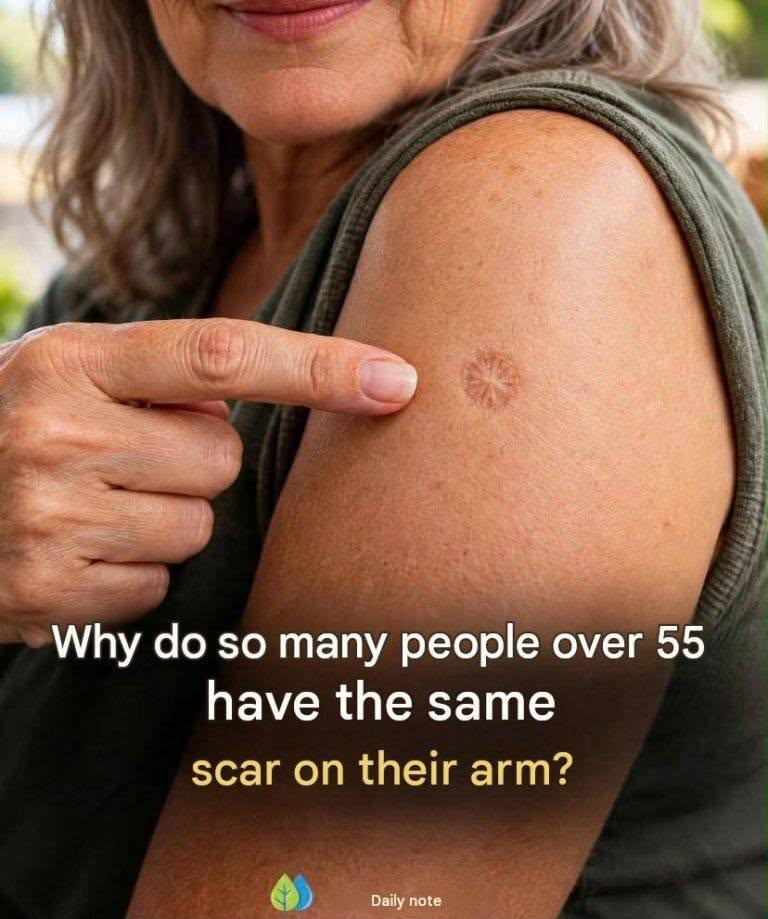
A quick glance around a crowded room, a family gathering, or a public swimming pool reveals a quiet, almost universal pattern among older generations: a small, circular, slightly sunken scar on the upper left arm. For millions of people born before a certain era, this mark is as familiar as a freckle, yet its origins are often forgotten or misunderstood. The viral question—”Why do so many people over 55 have the same round scar on their arm?”—taps into a collective curiosity about a piece of living history that is slowly fading from the population.
The answer is not a mystery, nor is it a sign of a hidden disease. The scar is the indelible legacy of the smallpox vaccine, a medical intervention that played a pivotal role in one of the greatest public health achievements in human history: the eradication of a virus that had plagued humanity for millennia. Understanding why this scar exists, how it was created, and why it is becoming a relic of the past offers a fascinating glimpse into the history of medicine, immunology, and the power of global cooperation.
The Smallpox Vaccine: A Brief History
Smallpox was a devastating disease caused by the variola virus. It was highly contagious and had a mortality rate of around 30%, with survivors often left with severe scarring and, in some cases, blindness. For centuries, it was one of the most feared diseases in the world.
The Birth of Vaccination
The story of the smallpox vaccine begins with Edward Jenner, an English physician who, in 1796, observed that milkmaids who had contracted cowpox (a milder, related virus) seemed to be immune to smallpox. He famously inoculated a young boy with material from a cowpox sore and then exposed him to smallpox, finding that the boy was protected. This was the birth of vaccination, a term derived from the Latin word for cow, vacca.
The Global Eradication Campaign
For nearly two centuries, smallpox vaccination was a routine part of childhood in many countries. The vaccine was incredibly effective. In 1967, the World Health Organization (WHO) launched an intensified global campaign to eradicate the disease. Through a combination of mass vaccination, surveillance, and ring vaccination (vaccinating people around each case to create a buffer of immunity), the campaign was a resounding success. In 1980, the WHO officially declared smallpox eradicated. It remains the only human disease to have been completely eliminated.
Why the Scar Looks the Way It Does
The distinctive appearance of the smallpox scar is not an accident. It is the direct result of the specific method used to administer the vaccine.
The Bifurcated Needle Technique
Unlike modern vaccines, which are typically injected deep into the muscle, the smallpox vaccine was administered into the skin. A special tool called a bifurcated needle was used. This needle had two prongs and was dipped into the vaccine solution. The healthcare worker would then rapidly prick the skin of the upper arm 15 to 20 times in a small circular area.
The “Take” and the Scar
This technique deliberately introduced a live, weakened virus (vaccinia) into the skin. Within a few days, a red, itchy bump would appear. Over the next week or two, it would develop into a blister, then a pustule, and finally a scab. The appearance of this reaction was called a “take,” and it was a sign that the vaccination was successful and the person was protected. When the scab fell off after a few weeks, it left behind a permanent, slightly depressed scar, which is essentially the body’s record of fighting off that localized infection.
Why It’s Common in People Over 55
The prevalence of the scar in people over 55 is a simple matter of timing. In the United States, routine smallpox vaccination was discontinued in 1972, after the disease had been largely eliminated in the country. In the United Kingdom, routine vaccination ended in 1971. This means that anyone born and vaccinated before those dates—which includes most people who are now in their 50s, 60s, and older—would carry the mark.
A Fading Generational Marker
As time passes, this scar is becoming a fading generational marker. Younger people, born after the vaccine was discontinued, do not have it. The scar is a visible reminder of a time when smallpox was a real threat and vaccination was a universal rite of passage. It is a piece of living history on the skin of millions of people.
What the Scar Does Not Mean
It is important to dispel some common misconceptions about the smallpox scar.
It Does Not Mean You Are Still Protected Against Smallpox
The smallpox vaccine provides long-term immunity, but it is not necessarily lifelong. However, because smallpox has been eradicated, there is no need for booster shots or ongoing protection. The scar is a historical record, not a current indicator of immunity status.
It Is Not a Sign of a Hidden Disease
The scar is a normal, benign result of a vaccine. It is not a sign of cancer, infection, or any other medical condition. It is simply a healed wound.
It Is Not a Vaccine “Tattoo” in the Modern Sense
Some people have mistakenly referred to the smallpox scar as a “vaccine tattoo.” While it is a permanent mark, it was not created with ink. It is a scar, formed by the body’s immune response to the vaccine.
When to Pay Attention to the Scar
While the scar itself is harmless, it is always wise to monitor any scar on your body for changes. You should consult a doctor if the scar begins to change after years of stability. Warning signs include:
New growth or a lump appearing within the scar
Bleeding or ulceration
Persistent pain or itching
A change in color or shape
These changes are usually unrelated to the original vaccine, but they should always be evaluated by a medical professional to rule out skin cancer or other conditions.
The Legacy of the Smallpox Vaccine
The smallpox scar is more than just a physical mark. It is a symbol of one of the most successful public health campaigns in history. It represents a time when the world came together to fight a common enemy and succeeded. The scar is a reminder of the power of vaccines to save lives and eradicate disease. It is also a reminder of the importance of continued vigilance and public health efforts.
Conclusion: A Historical Mark on the Skin
The round scar on the arm that many people over 55 share is a smallpox vaccination scar. It is a benign, permanent mark left by a vaccine that helped eradicate one of the deadliest diseases in human history. Its prevalence in older generations is a simple reflection of when routine vaccination was discontinued. The scar is a piece of living history, a testament to the power of science and global cooperation. While it may fade from the population over time, its legacy—the eradication of smallpox—will endure forever.
Frequently Asked Questions
What is the round scar on the arm that many older people have?
It is a smallpox vaccination scar. It was left by the vaccine that was routinely given to children until the 1970s.
Why do people over 55 have this scar?
Routine smallpox vaccination was discontinued in the United States in 1972 and in the UK in 1971. People vaccinated before those dates, who are now in their 50s and older, carry the mark.
Is the scar dangerous?
No. The scar is a normal, benign result of the vaccine. It is not a sign of disease. However, as with any scar, you should monitor it for changes and see a doctor if it grows, bleeds, or becomes painful.
Does the scar mean I am still protected against smallpox?
The vaccine provides long-term immunity, but because smallpox has been eradicated, there is no need for ongoing protection. The scar is a historical record, not a current indicator of immunity.
Why does the scar look like a circle?
The vaccine was administered using a bifurcated needle that pricked the skin multiple times in a small circular area. The resulting immune reaction and healing process created the characteristic circular scar.
Can I get the smallpox vaccine today?
The smallpox vaccine is not routinely available to the general public. It is only used in specific circumstances, such as for laboratory workers who handle the virus or for military personnel.