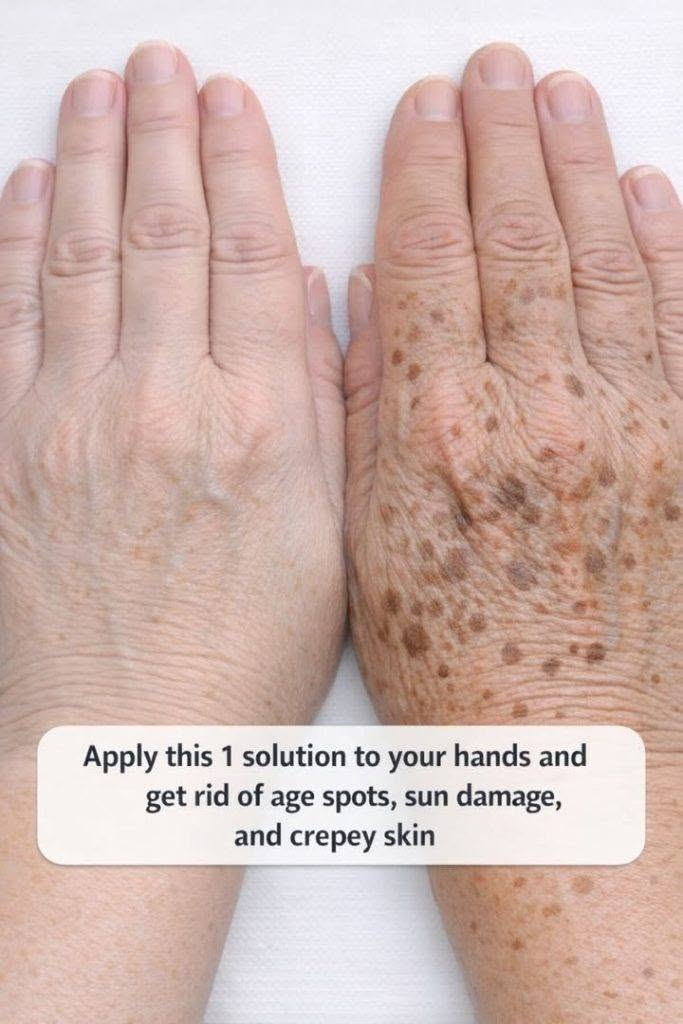
The image is striking: two hands side by side, one smooth and relatively clear, the other covered in dark brown spots and textured with fine, crepey lines. The accompanying claim is bold—apply one solution for just three minutes and watch age spots, sun damage, and crepey skin disappear. It is a promise that catches attention, especially for anyone who has watched their own hands show the unmistakable signs of time and sun exposure.
The reality, however, is more nuanced than a viral post can capture. The hands in the image tell a real story about what happens to skin after decades of sun exposure, but the idea that a single three-minute application can reverse that damage is not supported by dermatological science. What the hands reveal is a process that happens gradually, and what actually works to address it requires consistency, patience, and a clear understanding of what is and is not possible with at-home care.
What the Image Really Shows: A Tale of Two Hands
The contrast in the photograph is dramatic, and it reflects a genuine phenomenon. The hand on the right displays classic signs of photoaging—the cumulative effect of ultraviolet radiation over many years. The dark spots are solar lentigines, commonly called age spots or sunspots. They are flat, brown or tan areas that develop when UV light stimulates melanin production, causing pigment to gather in concentrated clusters rather than spreading evenly .
The texture on that same hand, the fine crinkling that resembles tissue paper, is what is commonly described as crepey skin. It reflects thinning of the dermal layer, reduced collagen and elastin production, and a loss of the subcutaneous fat that once gave the skin volume and firmness . The hands are particularly vulnerable to these changes because they are exposed to the sun more consistently than almost any other part of the body, yet they are frequently neglected in daily skincare routines .
The hand on the left, by comparison, shows fewer spots and smoother texture. This difference is not the result of a three-minute remedy. It more likely reflects a lifetime of different habits—less cumulative sun exposure, more consistent protection, or simply genetic variation in how skin ages.
Why the “3-Minute Solution” Claim Falls Short
Viral posts about age spots often promote kitchen remedies, with lemon juice and baking soda being among the most frequently mentioned. The logic sounds appealing: lemon juice contains citric acid and vitamin C, which are known to have brightening properties, while baking soda acts as a gentle abrasive that can buff away dead skin cells.
However, dermatologists and skin scientists caution against applying lemon juice directly to the skin. Lemon juice has a pH of around 2 to 3, which is significantly more acidic than the skin’s natural pH of roughly 4.7 to 5.75 . This acidity can disrupt the skin barrier, cause irritation, and lead to inflammation. More concerning, lemon juice contains photosensitizing compounds called furocoumarins, which increase the skin’s sensitivity to UV rays. Applying lemon juice and then exposing the skin to sunlight can cause redness, swelling, and even blisters—and irritation itself can trigger post-inflammatory hyperpigmentation, making dark spots worse rather than better .
There is also no reliable evidence that lemon juice or baking soda can fade established age spots. The pigments in solar lentigines are produced by melanocytes deep within the skin, and surface-level applications cannot reach them in any meaningful way. A three-minute application might temporarily make the skin feel smoother due to the mild exfoliation, but it will not remove or significantly lighten pigmentation that has developed over years.
What Actually Causes Age Spots and Crepey Skin
Understanding the causes is essential for evaluating any treatment claim. Age spots are not caused by the liver, despite the misleading “liver spots” name. They are the result of overactive pigment cells. Ultraviolet light speeds up melanin production, and on skin that has had years of sun exposure, melanin becomes clumped or produced in high concentrations, creating the visible spots . Commercial tanning beds can cause the same effect.
Crepey skin has a different but related cause. It is linked to the thinning of the dermis, the middle layer of skin that contains collagen and elastin fibers responsible for firmness and elasticity. As collagen production declines with age—starting at roughly one percent per year after the mid-twenties—the skin loses its structural support . Sun damage accelerates this process by breaking down the dermal extracellular matrix. The result is skin that looks thin, wrinkled, and fragile, with a texture that resembles crepe paper.
Because these changes occur in the deeper layers of the skin, any treatment that aims to address them meaningfully must either penetrate those layers or stimulate the skin’s own repair processes over time. A three-minute surface application cannot accomplish this.
The Evidence-Based Approach to Fading Age Spots
Dermatological research has identified several approaches that can genuinely improve the appearance of age spots and sun-damaged skin, though none of them work in minutes. A systematic review of clinical trials for solar lentigines found that the most effective topical treatment was a combination of mequinol and tretinoin, achieving efficacy rates between 52.6 percent and over 80 percent, particularly for facial lesions . Laser therapies, including intense pulsed light and Q-switched lasers, demonstrated even higher success rates.
For at-home care, the evidence supports a consistent, layered approach. The first and most important step is sun protection. A broad-spectrum sunscreen with an SPF of at least 30, applied to the backs of the hands every morning and reapplied after washing, is the single highest-return habit for preventing new spots and preventing existing ones from darkening . This is the step most people skip, yet without it, any other treatment is undermined.
The second step involves topical brightening ingredients. Vitamin C, niacinamide, and alpha arbutin are among the actives that can help fade existing pigmentation over time by inhibiting melanin production or promoting cell turnover . Retinoids, available over the counter or by prescription, can also help by accelerating skin cell renewal and supporting collagen production. However, these ingredients require weeks to months of consistent use before meaningful change becomes visible. Improvement is measured in months, not minutes .
For more established pigmentation, in-office treatments such as intense pulsed light, laser therapy, or chemical peels can be effective. These approaches are faster than topical care, but they still typically require a course of treatment rather than a single session, and they are not without cost and recovery time .
Addressing Crepey Skin Realistically
Crepey skin on the hands responds to a different but overlapping strategy. The priority at home is barrier repair and sustained hydration. Well-hydrated skin looks plumper and reflects light more evenly, which visibly softens the appearance of crepiness even before any structural changes occur . Humectants like hyaluronic acid draw water into the skin, while occlusive ingredients and emollients help hold it there. Applying a treatment-grade hand cream after every wash is the foundation of this approach.
Retinol can support collagen production and improve texture over time, though hand skin is thin and can be sensitive, so it should be introduced gradually and always used alongside daily sun protection . For significant crepiness and volume loss, procedures such as radiofrequency, laser resurfacing, or dermal fillers may be considered, but these are medical treatments that require consultation with a qualified professional.
What does not work for crepey skin is a brief, harsh application of acidic kitchen ingredients. Irritation and inflammation can further damage the skin barrier and accelerate the appearance of aging, creating a cycle that is difficult to reverse .
Why the “Mom Trick” Narrative Persists
The story of a mother’s simple trick is appealing because it promises something for nothing—a shortcut to a problem that otherwise requires effort, patience, and often expense. It taps into a genuine desire for accessible solutions and a distrust of complicated or costly skincare.
There is also a kernel of truth buried in some of these remedies. Lemon juice does contain vitamin C, which has legitimate antioxidant and brightening properties. Baking soda can provide mild physical exfoliation. But the form, concentration, and delivery method matter enormously. A splash of lemon juice from the kitchen is not the same as a formulated serum that delivers a stable, measured dose of vitamin C to the skin without disrupting its barrier.
The hands in the image are real, and the concern they represent is valid. Age spots and crepey skin are common, harmless, and entirely normal signs of a life lived in the sun. But the solution is not a three-minute paste. It is a routine: daily sun protection, consistent hydration, targeted topical treatments used over months, and, for those who want faster or more dramatic results, professional guidance.
Conclusion
The image of two hands—one marked by time and sun, the other relatively unblemished—captures a real and relatable concern. The claim that a single solution can erase age spots and crepey skin in three minutes does not hold up to scientific scrutiny. What the evidence supports is a more measured approach: protect the hands from the sun every day, nourish and hydrate the skin consistently, and use proven brightening and collagen-supporting ingredients with patience. For those who want to go further, dermatological treatments offer options that are faster and more effective than any kitchen remedy. The truth is not as simple as a viral post, but it is far more useful.
Frequently Asked Questions
Can lemon juice and baking soda remove age spots in three minutes?
No. There is no reliable evidence that a lemon juice and baking soda paste can remove or significantly fade age spots, especially in three minutes. Lemon juice is highly acidic and can irritate the skin, and its photosensitizing compounds can make the skin more vulnerable to sun damage. Irritation can actually worsen pigmentation .
What are age spots, and why do they appear on the hands?
Age spots, also called solar lentigines or sunspots, are flat, brown or tan areas caused by overactive pigment cells. Years of ultraviolet exposure cause melanin to clump or be produced in high concentrations, creating visible spots. The hands are among the most sun-exposed areas of the body, making them a common site for these spots .
What actually works to fade age spots on the hands?
The most effective approach combines daily broad-spectrum sunscreen with proven topical ingredients such as vitamin C, niacinamide, alpha arbutin, or retinoids. These require consistent use over weeks to months to show results. For faster or more significant improvement, in-office treatments like intense pulsed light or laser therapy are available through a dermatologist .
Can crepey skin on the hands be treated at home?
Yes, but improvement is gradual. The foundation is daily sun protection and consistent hydration with a quality hand cream containing humectants and emollients. Retinol can help support collagen and improve texture over time, but it should be introduced gradually and paired with sun protection. Significant crepiness may require professional treatments such as laser resurfacing or radiofrequency .
When should I see a doctor about a spot on my hand?
You should have a doctor examine any spot that is black, is increasing in size, has an irregular border, contains an unusual combination of colors, or is bleeding. These changes can be signs of melanoma, a serious form of skin cancer. New or changing skin lesions should always be evaluated by a medical professional .