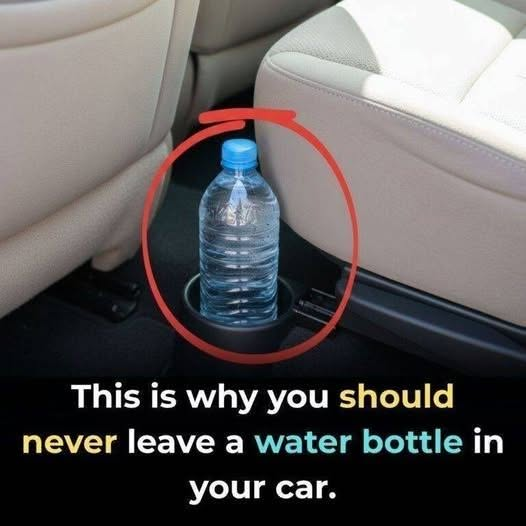
A single clear plastic water bottle left in a car’s cup holder on a sunny day looks completely harmless. It is a familiar sight, especially during warmer months, when drivers keep a bottle on hand to stay hydrated. Yet this ordinary object can create two distinct problems inside a parked vehicle: a fire hazard caused by concentrated sunlight, and a hidden health risk from chemicals and bacteria that thrive in heat.
The image of a water bottle sitting in a car’s cup holder, highlighted with a red circle, captures exactly the kind of everyday scenario that safety experts warn against. Understanding what happens to both the vehicle and the water inside that bottle requires looking at how a car’s interior behaves in the sun and what heat does to plastic.
How a Water Bottle Can Start a Fire in a Parked Car
The fire risk comes from a simple principle of optics. A clear plastic bottle filled with clear liquid can act like a magnifying glass, focusing sunlight into a concentrated beam of heat on a single spot inside the car . If that focused beam lands on a flammable material—a seat cover, a plastic panel, carpeting, or a piece of paper—it can scorch or even ignite it.
This is not a theoretical concern. A Texas man went viral after showing the scorched interior of his Jeep, which he attributed to a water bottle left on the front seat that focused sunlight onto the upholstery . In another reported case, a woman in Arizona found that a plastic water bottle had burned holes into her car seat . Emergency medicine physician Dr. Gérald Kierzek has also warned that the reflected rays through water and plastic can be powerful enough to set fire to seats or other materials inside the vehicle .
The risk depends on a specific combination of factors: a clear bottle, clear liquid inside, direct sunlight hitting the bottle at the right angle, and a flammable surface positioned where the focused light lands. It does not happen every time a bottle is left in a car, but it only takes one instance for the consequences to be severe.
The Health Risks of Drinking Water Left in a Hot Car
Even if no fire occurs, the water inside a bottle that has been sitting in a hot car is not something you should drink. Two separate problems make it unsafe: chemical leaching from the plastic and rapid bacterial growth.
Chemicals and Microplastics from Heated Plastic
Most disposable water bottles are made from polyethylene terephthalate, or PET. When this material is exposed to high temperatures, its structure can begin to break down, releasing chemicals into the water . These include antimony, a heavy metal, and bisphenol A (BPA), a compound associated with hormonal disruption . Research has shown that when plastic bottles are exposed to heat, both antimony and BPA can leach into the water inside .
Heat also accelerates the release of microplastics and nanoplastics from the plastic into the water . A Canadian study from McGill University found that plastic water bottles heated to around 37°C released micro- and nano-sized particles, while control bottles kept at refrigerator temperatures of about 4°C showed almost no particle release . The inside of a parked car can far exceed 37°C, making the conditions for particle release even more favorable.
Bacterial Growth in Warm, Dark Conditions
If you have already taken a sip from the bottle, the situation becomes worse. Bacteria from your mouth enter the water, and the warm, dark, enclosed environment of a car interior becomes an ideal breeding ground . One experiment testing bacterial changes in plastic water bottles found that after a person drank directly from a bottle, bacterial counts jumped dramatically, and in summer temperatures, bacteria could multiply to very high levels within just a few hours .
Dr. Jane Sadler, a family medicine physician, explained the problem plainly: “Bacteria loves heat, and it loves moisture. If you think about all of the bacteria in your mouth, that’s what’s being regenerated and rejuvenated in the bottle” . Drinking that water means introducing a large dose of bacteria back into your system, which can cause digestive trouble or other illness .
How Hot Does a Car Interior Actually Get?
The severity of both risks depends on temperature, and the numbers are striking. A car parked in direct sunlight can heat up far faster and far more than most people expect.
According to research published in the Bulletin of the American Meteorological Society, the interior air temperature of a closed car can rise by about 4°C in five minutes, 7°C in ten minutes, 16°C in thirty minutes, and 26°C in one hour. After an hour in direct sunlight, the air temperature inside the vehicle can reach 57°C, or 135°F . Other measurements have recorded even higher extremes, with small cars in direct sun reaching temperatures as high as 78°C in some studies .
A study tracking vehicles in Tempe, Arizona, found that in cars parked in the sun on hot summer days, the average cabin temperature hit 46°C within one hour. The dashboard averaged 69°C, the steering wheel 53°C, and the seats 51°C . These are temperatures well above the threshold at which plastic bottles begin to degrade and release chemicals, and well within the range where focused sunlight can cause damage to interior materials.
What to Do Instead: Practical Alternatives
The simplest solution is also the most effective: do not leave plastic water bottles in a parked car. But for drivers who want to keep water available, several practical alternatives reduce the risk.
Choose a Different Bottle Material
Stainless steel and glass bottles do not leach chemicals when exposed to heat and do not create the same magnifying-glass effect as clear plastic . They are better choices for any water kept in a vehicle, though even these should ideally be stored out of direct sunlight.
Store Bottles Out of Direct Sun
If a bottle must remain in the car, place it somewhere the sun cannot reach it directly. The trunk is a better option than a cup holder or seat, and covering the bottle or placing it in a closed compartment can also block sunlight . The key is to eliminate the direct beam that creates both the fire risk and the focused heat.
Treat Opened Bottles as Disposable
A bottle that has already been drunk from should not be left in a hot car and consumed later. Health experts recommend discarding water from a partially consumed bottle that has been left in the heat, regardless of the container type . For reusable bottles, washing thoroughly with hot, soapy water after each use is essential to prevent bacterial buildup .
Conclusion
A water bottle in a car’s cup holder is easy to overlook, but the evidence is clear that it is not a harmless habit. In the right conditions, a clear plastic bottle can focus sunlight intensely enough to scorch or ignite interior materials. Even when no fire occurs, the heat inside a parked car can cause chemicals and microplastics to leach from the plastic into the water, while warmth and moisture create a breeding ground for bacteria.
The solution is straightforward: do not store plastic water bottles in a parked car. Choose stainless steel or glass, keep any bottle out of direct sunlight, and discard water from bottles that have been left in the heat. These small changes protect both the vehicle and the person drinking from the bottle.
Frequently Asked Questions
Can a water bottle really start a fire in a car?
Yes, it can, though it is a rare occurrence. A clear plastic bottle filled with clear liquid can act like a magnifying glass, focusing sunlight into a concentrated beam that can scorch or ignite flammable materials such as seat upholstery or paper. The risk depends on the angle of the sun, the position of the bottle, and the material the focused light hits .
Is it safe to drink water from a bottle left in a hot car?
It is not recommended. Heat can cause plastic bottles to release chemicals such as antimony and BPA into the water, and it accelerates the shedding of microplastics. If the bottle has been opened and drunk from, warm conditions also promote rapid bacterial growth. Drinking such water may cause digestive issues or expose you to unwanted substances .
How hot does a car get in the sun?
A car parked in direct sunlight can heat up rapidly. Research shows that interior air temperature can rise by about 16°C in thirty minutes and 26°C in one hour, reaching 57°C or higher after an hour in direct sun. Dashboards and seats can become even hotter, with surface temperatures exceeding 50°C to 60°C .
What kind of water bottle is safe to leave in a car?
Stainless steel and glass bottles are safer choices because they do not leach chemicals when heated and do not create the magnifying-glass effect that clear plastic can. However, even these should be kept out of direct sunlight and should not be left in a hot car for extended periods .
Does the fire risk apply to all water bottles?
The magnifying-glass effect is most associated with clear plastic bottles containing clear liquid. Colored or opaque bottles, and bottles made of materials that do not transmit light, are far less likely to focus sunlight in the same way. An empty bottle does not create the same effect as one filled with liquid .