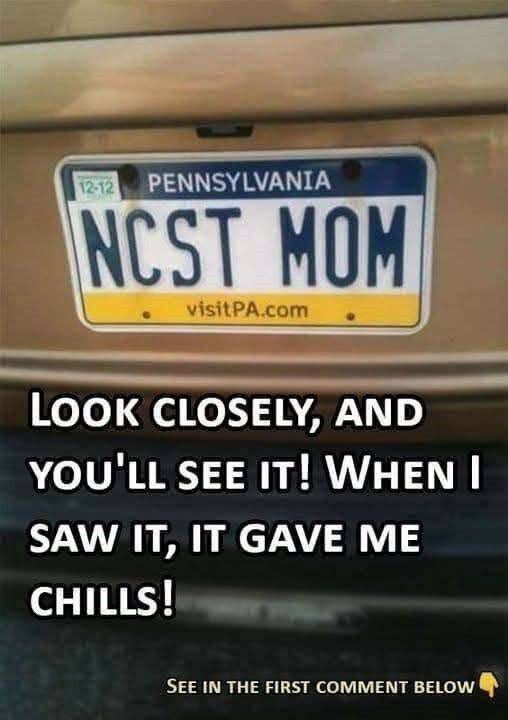
Vanity license plates are a beloved American tradition. They offer drivers a small, mobile canvas on which to display their personality, their profession, their favorite sports team, or a loving tribute to their family. However, the strict character limits and the uniform spacing of license plate manufacturing can sometimes turn a seemingly innocent phrase into something deeply unfortunate. Such is the case with a now-viral image of a Pennsylvania license plate that reads “NCST MOM.” The image is accompanied by a caption warning viewers to “look closely,” claiming the hidden message gave the poster “chills.” What the poster is referring to is not a supernatural mystery, but a classic example of accidental letter spacing that transforms a sweet message into a highly inappropriate one.
The Intended Meaning: A Tribute to Motherhood
To understand the joke, we first have to understand the intent. The driver of the vehicle almost certainly intended the plate to read as a phonetic abbreviation for “Nicest Mom.” The letters “NCST” are a common shorthand used in text messaging and online communication to represent the word “nicest.” Combined with “MOM,” the plate is meant to be a loving, public declaration of affection for the driver’s mother, or perhaps a self-congratulatory nod from a mother who takes pride in her parenting.
Vanity plates are regulated by state departments of motor vehicles (DMVs), which typically have committees dedicated to reviewing applications and rejecting anything that is deemed obscene, offensive, or misleading. However, the DMV reviews the requested letter combination, not necessarily how that combination might look to the human eye when printed on a physical plate. They approved “NCST MOM” because, in a vacuum, it is just a benign string of letters.
The Accidental Misreading: When Letters Merge
The problem lies in the visual presentation. On a standard license plate, the letters are spaced evenly, with no large gaps to indicate where one word ends and another begins. When you look at the plate quickly, your brain doesn’t read each letter individually; it processes the visual shapes as a whole.
Because there is no space between the “N” and the “C,” the brain easily groups those letters together with the following “S” and “T” to form a completely different, and highly offensive, four-letter word. Instead of seeing “N-C-S-T” (Nicest), the eye sees a word that begins with “I-N-C-E-S-T.”
The caption’s warning to “look closely” is a classic internet engagement tactic. It creates a sense of mystery, prompting viewers to stare at the image until they experience the sudden “aha!” moment of seeing the unintended word. It is a prank based entirely on visual perception.
The Psychology of Visual Misreading
This phenomenon is a testament to how remarkably efficient, yet sometimes flawed, human visual processing is. Our brains are wired to recognize patterns quickly, especially familiar words and faces. When we encounter a string of letters, our brains immediately begin searching our mental dictionary for a match.
The brain is also highly sensitive to the context of the first letter. Because the “N” and “C” are placed so closely together, the space between them is minimized. The brain’s pattern recognition software “corrects” the image, filling in the blanks to create the most familiar (and in this case, most jarring) word possible. This is similar to how optical illusions work; our brain interprets visual data in a way that makes logical sense to it, even if it contradicts the raw data.
The Broader Trend: Unfortunate Vanity Plates
This is not the first time a vanity plate has gone viral for unintended reasons. DMVs across the country have approved plates that were later revoked after the public pointed out the hidden meanings. Examples include:
“3M TA3” (which, when viewed in a mirror, reads “EAT ME”).
“NO TAG” (a plate that looks like a generic placeholder but was actually a real vanity plate).
“H20” (which the owner intended to mean “water,” but which the DMV later revoked because it was deemed to be promoting alcohol).
DMVs are increasingly using sophisticated software and human review committees to catch these issues before the plates are issued. However, as the “NCST MOM” plate proves, it is nearly impossible to anticipate every possible misinterpretation of a string of letters.
Conclusion
The “NCST MOM” license plate is a hilarious, if unfortunate, example of how a well-intentioned message can be completely derailed by the mechanics of visual perception. The driver likely set out to celebrate their mother, but ended up with a viral internet puzzle. The next time you see a vanity plate, take a moment to look at it from a distance, or squint your eyes. You never know what hidden, and possibly inappropriate, message might be lurking in plain sight.
Frequently Asked Questions
What does the “NCST MOM” license plate actually mean? The driver intended it to mean “Nicest Mom.” “NCST” is a common internet abbreviation for “nicest.”
Why does it look like a bad word? Because there is no space between the “N” and the “C,” the letters visually run together. The brain groups the “N” with the following letters, creating a word that begins with “INCEST.”
Did the DMV approve this plate? Yes, the Pennsylvania DMV approved it because the letters “NCST MOM” are not inherently offensive. The offensiveness only emerges when the letters are viewed on the physical plate and visually misread.
Are vanity plates reviewed for inappropriate content? Yes, most state DMVs have a review process to reject plates that are obscene, offensive, or misleading. However, they cannot anticipate every possible visual misinterpretation.
Can a license plate be revoked after it is issued? Yes. If a DMV receives enough complaints or if a plate is found to violate their guidelines after issuance, they can recall the plate and require the driver to surrender it.