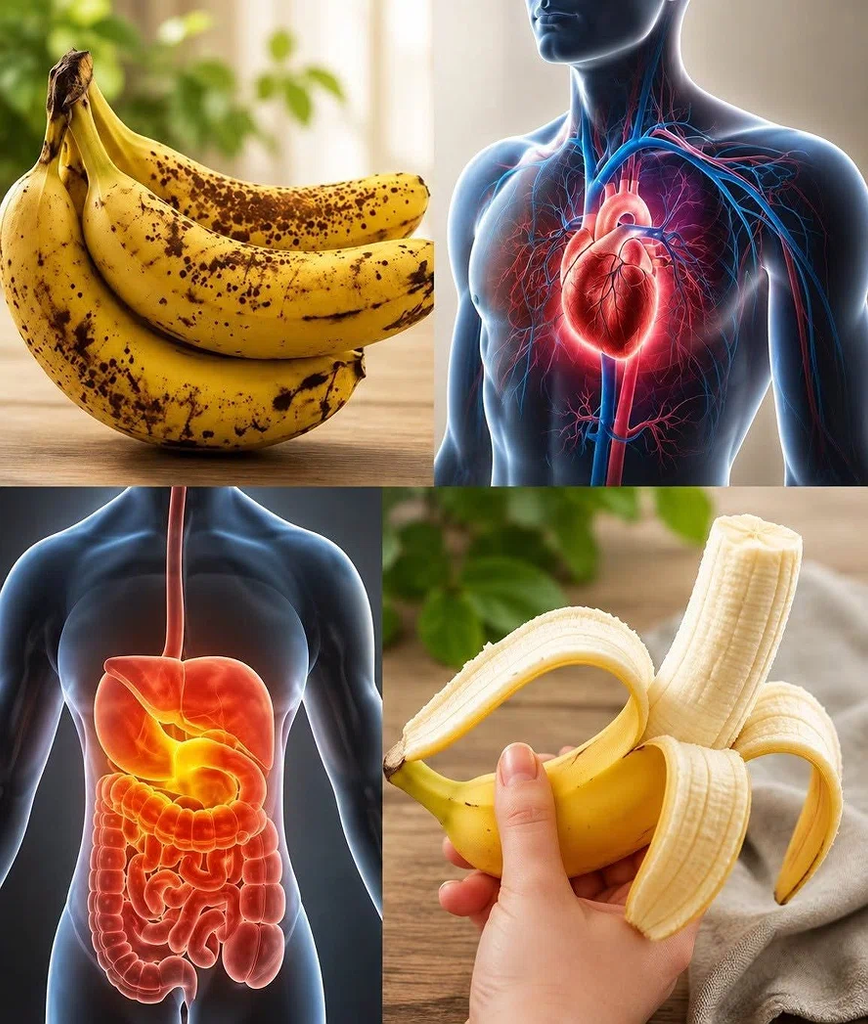
The image presents a simple but evocative pairing: a bunch of ripe, speckled bananas alongside a detailed anatomical illustration of the heart, and a peeled banana next to the human digestive tract. The implication is clear: eating bananas has a direct, measurable impact on your cardiovascular and digestive systems. This visual raises the question of what, precisely, bananas “increase.” Do they increase potassium? Fiber? Heart health? The answer is that bananas can influence several key physiological functions, but the reality is far more nuanced than a simple before-and-after graphic. Understanding what bananas actually do—and what they do not do—requires looking at the science behind their nutrients.
The Nutritional Foundation: What Is Actually in a Banana?
Before examining specific health effects, it helps to establish the baseline. A medium-sized ripe banana contains approximately 105 calories, 3 grams of fiber, and a significant amount of potassium. According to the American Heart Association, one medium banana provides about 375 milligrams of potassium, which represents roughly 11% of the recommended daily intake for men and 16% for women . The Cleveland Clinic notes that a medium banana also provides about 422 milligrams of potassium and 3 grams of fiber, which is nearly 10% of the recommended daily value .
The primary nutrient associated with bananas is potassium. As the National Institutes of Health explains, potassium is a mineral that helps the body’s nerves function, muscles move, and the heart beat, and it helps balance the harmful effects of salt on blood pressure . This is the scientific basis for the heart-related claims often attached to bananas.
Bananas and the Heart: The Potassium-Sodium Connection
The top half of the image, linking bananas to the heart, points toward the most well-established nutritional relationship. The American Heart Association states that foods rich in potassium are important in managing high blood pressure because potassium reduces the effects of sodium. The more potassium you eat, the more sodium you lose through urine, and potassium also helps ease tension in blood vessel walls, which helps lower blood pressure .
Research supports this connection. A 2025 study published in the American Journal of Physiology–Renal Physiology and covered by Harvard Health found that increasing dietary potassium while reducing salt might be more effective in lowering blood pressure than cutting back on salt alone. The researchers suggested that eating potassium-rich foods like bananas might encourage the kidneys to excrete more sodium and water, thereby lowering blood pressure . A separate mathematical modeling study from the University of Waterloo similarly suggested that increasing the ratio of potassium to sodium in the diet may be more effective for lowering blood pressure than simply reducing sodium intake .
What Bananas Do Not Do for the Heart
It is important to separate evidence-based benefits from popular myths. While bananas contribute potassium to the diet, they are not a standalone cure for hypertension. The American Heart Association emphasizes that potassium-rich foods are part of a broader approach that includes reducing sodium and following an overall healthy eating pattern . Additionally, for individuals with kidney disease or those taking certain medications that affect potassium levels, increasing potassium intake can be dangerous. The AHA advises that people with kidney disease or conditions affecting potassium handling should consult a healthcare professional before increasing potassium intake .
Bananas and Digestion: Fiber, Ripeness, and Gut Health
The bottom half of the image, connecting a peeled banana to the digestive system, highlights another area where bananas have earned a reputation. The Cleveland Clinic notes that bananas contain both insoluble and soluble fiber, which helps keep bowel movements regular and boosts the gut microbiome. The fruit is also gentle on the gastrointestinal tract, which is why it is a staple of the BRAT diet (bananas, rice, applesauce, toast) used for easing an upset stomach .
The Constipation Controversy
Bananas have a somewhat contradictory reputation when it comes to constipation. Some people believe bananas cause constipation, while others rely on them to promote regularity. The evidence suggests that the truth depends on ripeness. According to a medical faculty article from the Université de Montréal, the idea that bananas cause constipation is largely a myth. While bananas contain soluble fiber that can help control stool consistency (which is why they are used for diarrhea), they do not cause constipation. The article notes that only about one-third of a banana’s fiber has this binding quality; the other two-thirds promote good elimination .
However, there is a caveat regarding ripeness. A report from Chinese health media notes that unripe bananas contain higher levels of tannic acid, which can bind with proteins in the stomach and potentially worsen constipation. The riper the banana, the less tannic acid it contains . For most people, a ripe banana is a gentle, fiber-rich food that supports digestive health, but it is not a potent laxative.
The Broader Context: What Bananas Increase and What They Don’t
So, what does eating bananas actually increase? The most accurate answer is that bananas increase your intake of potassium, fiber, and certain vitamins, which in turn support cardiovascular and digestive functions as part of a balanced diet.
They do not “increase” heart health in isolation. The heart benefits associated with bananas are tied to the potassium-sodium balance, and they are most meaningful when bananas replace less healthy snacks and are part of a diet rich in vegetables, whole grains, and lean proteins. Similarly, the digestive benefits are tied to their fiber content, but bananas are not a high-fiber powerhouse compared to legumes, berries, or whole grains.
The visual pairing of bananas with the heart and digestive system is not misleading, but it does oversimplify a nuanced relationship. Bananas are a convenient, accessible source of potassium and fiber. Their effects are gradual and cumulative rather than dramatic and immediate. They are a useful piece of a healthy eating pattern, not a shortcut to cardiovascular or digestive health.
Frequently Asked Questions
Do bananas really help lower blood pressure? Bananas contain potassium, which helps the body excrete excess sodium and eases tension in blood vessel walls. The American Heart Association recommends potassium-rich foods as part of a strategy to manage blood pressure, but bananas should be part of an overall healthy diet rather than a standalone treatment .
Are ripe or unripe bananas better for digestion? Ripe bananas are generally easier to digest and are less likely to contribute to constipation. Unripe bananas contain higher levels of tannic acid, which can have a binding effect in some individuals . The Université de Montréal notes that the idea bananas cause constipation is largely a myth, as most of their fiber promotes elimination .
How much potassium is in a banana? A medium banana provides approximately 375 to 422 milligrams of potassium, depending on the source and exact size. This represents roughly 10% to 16% of the recommended daily intake for adults .
Can eating too many bananas be harmful? For most healthy people, bananas are safe in moderation. However, individuals with kidney disease or those taking medications that affect potassium levels should consult a doctor before significantly increasing their potassium intake, as too much potassium can be harmful in these cases .
Are bananas good for digestion? Yes, bananas contain both soluble and insoluble fiber, which support regular bowel movements and gut health. They are also gentle on the stomach and are often recommended as part of the BRAT diet for easing gastrointestinal upset .